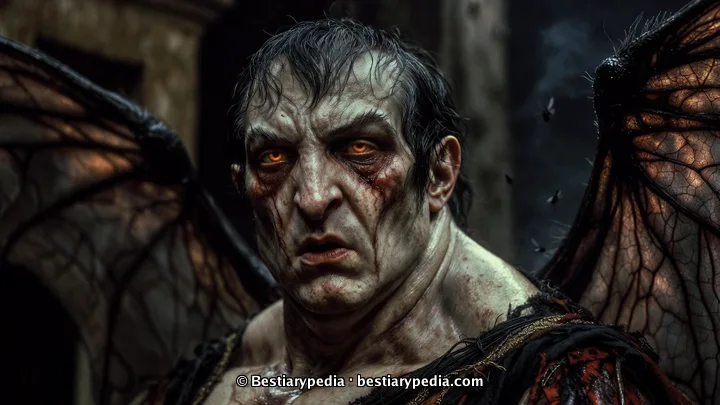
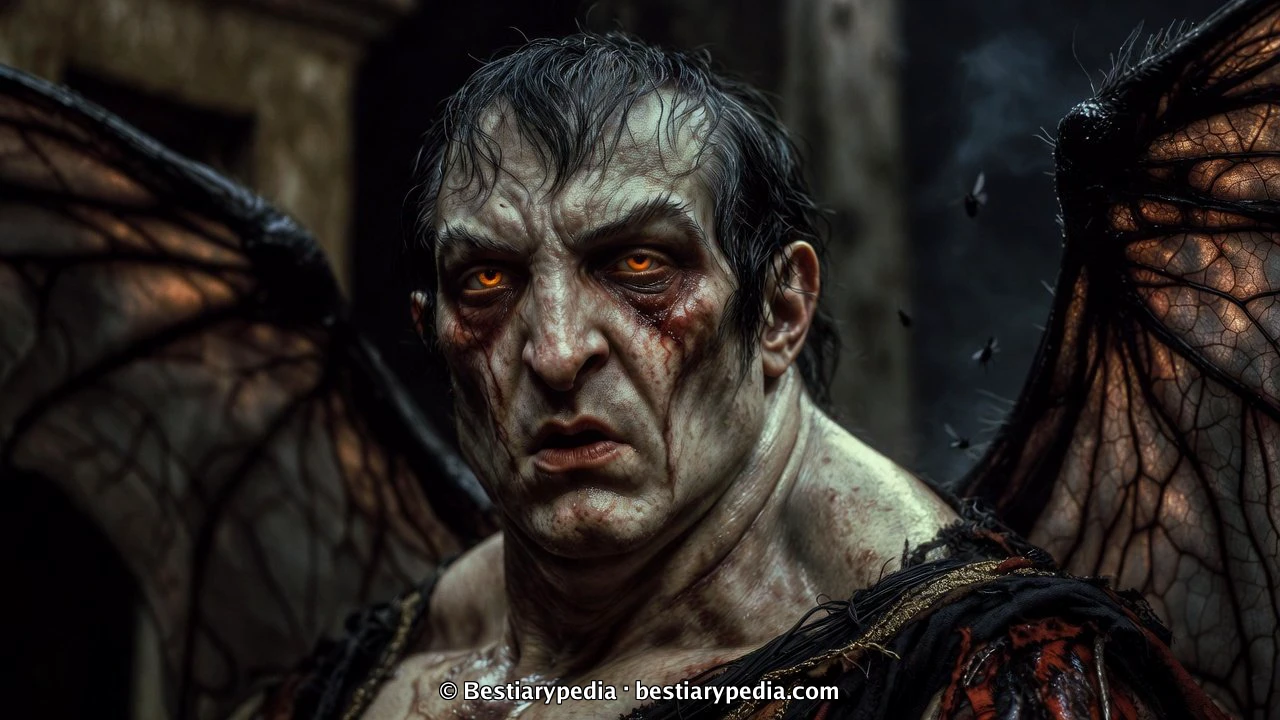
Belphegor
Belphegor, demonic prince of sloth and invention among the Princes of Hell
Curated byBestiarypediaCreated onUpdated on


Origins of Belfegor
Belfegor (Belphegor) derives from the biblical Baal-Peor, the god worshiped on Mount Peor mentioned in the Book of Numbers, in whose cult the people of Israel fell in Moab giving themselves to libertinism and idolatry. In its Canaanite origin, therefore, it was linked to fertility and excess. Medieval Christian demonology reinterpreted it and, in works like The Lanterne of Light (around 1409), it was classified as the demonic prince of sloth, one of the seven demons associated with the capital sins. Its role was consolidated in the Pseudomonarchia Daemonum by Johann Weyer (1577) and in the Dictionnaire Infernal by Collin de Plancy, where it is described as a demon that tempts men with ingenious inventions and riches obtained without effort.
Appearance and attributes
In the Dictionnaire Infernal, Belfegor is represented in two opposing ways: as a young woman of great beauty when he shows himself seductive, and as a monstrous demon, bearded, with horns, sharp nails and seated on a toilet or commode, a grotesque image that underscores his link with physical sloth and the eschatological. As prince of acedia (spiritual sloth), he personifies the temptation to abandon effort and discipline in exchange for easy pleasures and quick gains. Tradition attributes to him inspiring discoveries and inventions that promise enrichment without work, so that his influence is associated with greed disguised as comfort and the search for shortcuts.
Invocation and legacy
According to the grimoires, Belfegor was invoked to obtain riches and lucrative inventions, and he was attributed with granting ingenious ideas in exchange for subjecting the invoker to softness and dependence. His figure later inspired the literary tradition: Niccolò Machiavelli wrote a celebrated satirical novella, La favola di Belfagor arcidiavolo, in which the demon ascends to the world of the living to ascertain whether marriage is truly a torment, and the motif reappears in later authors. Belfegor thus endures as the demonic archetype of sloth and wealth without merit, a moral warning, inherited from the biblical condemnation of Baal-Peor, against those who seek profit and pleasure by avoiding all effort.
Also known as
Relics
🏺 Scepter of Sloth
Tool with which Belphegor blesses lazy inventions and wealth without effort, symbol of demonic temptation by sloth.
Symbology
Element
Stagnant Earth
Number
13
Color
Dark Purple
Animals
Distorted Goat, Terrifying Elephant
Sigils:
🏷️ Traits
Powers
Weaknesses
Behavioral
Resistances
🔗 Relations with other beings


🗺️In the Atlas
Travel the beings’ world of origin and the cosmos of their dimensions.
📜 Mythologies
The Abrahamic religions comprise Judaism, Christianity and Islam, three monotheistic traditions that share a common origin in the figure of Abraham, regarded as patriarch in all three. Originating in the ancient Near East, Judaism developed among the Hebrews during the second millennium BCE, Christianity arose in the 1st century CE in the context of Second Temple Judaism and Islam appeared in the 7th century on the Arabian Peninsula. Each is based on divine revelations transmitted through prophets and sacred scriptures, such as the Torah, the Bible and the Qur'an, and upholds the belief in a single creator and judge God.
Sources
Pseudomonarchia Daemonum
Johann Weyer · 1577
Catalogue of sixty-nine demons included by Johann Weyer in his work "De praestigiis daemonum" (1577). It describes the infernal hierarchy, its ranks and offices, and is the direct precedent of the Ars Goetia and later Western demonology.
Dictionnaire Infernal
Collin de Plancy · 1818
Demonological dictionary by Collin de Plancy (1818), famous for the illustrations by Louis Le Breton in its 1863 edition. It catalogues demons, superstitions and infernal beings, and popularized the visual image of many entities of goetia.
Book of Numbers
Moses (traditionally attributed) · ca. 1440 BCE
The fourth book of the Torah details Israel's censuses, rebellions in the wilderness, miracles, and preparations to enter Canaan under Moses.
Frequently asked questions
How is Belphegor connected to the biblical god Baal-Peor in the Book of Numbers?
Belphegor is considered a demonic evolution of the Canaanite god Baal-Peor. In the Book of Numbers he seduced the Israelites in Moab with debauchery linked to fertility. This biblical figure transformed in medieval demonology into the prince of sloth.
What characteristic attributes and powers are attributed to Belphegor in the grimoires?
Belphegor is lord of the mines and is credited with discovering artillery as a symbol of power without effort. He is associated with the invention of easy riches and the induction of idleness among those who invoke him.
What relationships does Belphegor maintain with other demonic princes in the infernal hierarchy?
Belphegor serves as one of the princes under Satan in the infernal hierarchy. He is an ally of Asmodeus and Beelzebub, sharing with them the temptations of the deadly sins in the demonic court.
What symbolic and iconographic elements define the representation of Belphegor?
Belphegor appears in grimoires with an elephant or distorted goat head, seated on a toilet throne symbolizing physical and spiritual sloth. His symbols include the number 13, dark purple color, the stagnant earth element and the goetic sigil with latrine throne.
🔖Cite this entry▾
If you cite this article in an academic, journalistic or editorial publication, use any of these formats:
Bestiarypedia. (2026, July 16). Belphegor. Bestiarypedia. https://bestiarypedia.com/en/beings/belphegor
Free citation with attribution and canonical link for editorial, academic or journalistic use. Full commercial reuse or creation of derivative products requires prior agreement.