Apollo
Apollo, Greek god of music, prophecy, healing, the sun and the arts
Curated byBestiarypediaCreated onUpdated on
 Ancient Greece(Greece)




Mythical Origins of Apollo
Apollo was born on the island of Delos, son of Zeus and the Titaness Leto. Pursued by Hera's jealousy, Leto wandered without finding land that would receive her until the wandering islet of Delos gave her refuge; there, at the foot of Mount Cynthus, she gave birth first to Artemis and then to Apollo. Once grown, the god went to Pytho, on the slopes of Parnassus, where he struck down with his arrows the serpent Python, guardian of the ancient sanctuary, and established over it his oracle of Delphi. This combat is narrated in the Homeric Hymn to Apollo (Hymn 3, vv. 300-374) and in Ovid's Metamorphoses (Book I), not in Hesiod's Theogony, which only relates the birth of the god and his sister (vv. 918-920). In commemoration of the feat the Pythian Games were held.
Attributes and Symbols of Apollo
Apollo is depicted as a youth of perfect beauty, the embodiment of harmony and moderation. His main attributes are the lyre, the bow and the laurel. The lyre, according to the Homeric Hymn to Hermes, was given to him by his brother Hermes in exchange for the cattle that the latter had stolen from him, and with it he presides over music, song and poetry as leader of the Muses (Musagetes). The silver bow distinguishes him as an unerring archer and as the god who sends the plague or wards it off, as well as patron of healing, a gift he passed on to his son Asclepius. The laurel became his sacred tree after his pursuit of the nymph Daphne, who while fleeing from him was transformed into a laurel according to Ovid (Metamorphoses I); with its leaves the victors of the contests were crowned. As lord of Delphi he exercised prophecy through the mouth of the priestess Pythia. Only in late times was he identified with the sun, from which he took the epithet of Phoebus, that is, the Bright One.
Worship and Legacy of Apollo
Apollo was one of the most venerated gods of Greece. His two most famous centres of worship were Delos, the island of his birth, and Delphi, seat of his oracle, to which cities and private individuals came in search of counsel. In his honour the Pythian Games were held, with contests of music and athletics, as well as festivals such as the Carneia and the Thargelia. Pausanias, in his Description of Greece, and Callimachus, in his Hymns, describe numerous temples and rites consecrated to the god, and Apollodorus gathers his myths in the Library. The Romans adopted him under the same name and the epithet of Phoebus, and the emperor Augustus made him protector of his regime. A symbol of reason, light and balance, his figure later inspired the Renaissance and modern art.
Also known as
Relics
🏺 Apollo's Lyre
Golden instrument forged by Hephaestus, gift from Hermes, symbol of musical harmony.
Symbology
Element
Solar Fire
Number
Seven
Color
Gold
Animals
Raven, Swan, Wolf
Sigils:
🏷️ Traits
Powers
Weaknesses
Behavioral
Resistances
🗺️In the Atlas
Travel the beings’ world of origin and the cosmos of their dimensions.
📜 Mythologies
Greek mythology developed in Ancient Greece from the Late Bronze Age and reached its most elaborate form during the archaic and classical periods, between the 8th and 4th centuries BCE. It emerged among the Hellenic peoples who inhabited the Greek peninsula, the Aegean islands and the coasts of Asia Minor, and was transmitted mainly through the oral poetry of Homer and Hesiod, as well as local traditions collected in sanctuaries and festivals. Its worldview presents a universe ordered by a hierarchy of divinities that intervene in human and natural affairs, with Olympus as the dwelling of the principal gods and Hades as the destination of the deceased. The central deities include the twelve Olympians, headed by Zeus, god of the sky and sovereign, together with Hera, Poseidon, Athena, Apollo, Artemis, Aphrodite, Ares, Hephaestus, Hermes, Demeter and Dionysus. Before them, the Titans, among whom Cronus and Rhea stand out, ruled the cosmos until they were deposed by the Olympians in the Titanomachy. Other important entities are the Muses, the nymphs, the Cyclopes and the Moirai, who embody cosmic forces and destinies. This tradition exerted a lasting influence on the literature, art and thought of Rome, the European Renaissance and subsequent Western culture, supplying motifs, characters and narrative structures that have endured in philosophy, astronomy and the arts to the present day.
Sources
Hymns
Calímaco de Cirene · -250
Collection of six hymns by the Hellenistic poet Callimachus of Cyrene (3rd c. BCE) to various Greek deities.
Homeric Hymn to Apollo
Anonymous (attributed to Homer) · -600
Archaic Greek hymn (7th-6th c. BCE) attributed to Homer, recounting Apollo's birth on Delos and the founding of his oracle at Delphi.
Theogony
Hesiod · -700
Poem by Hesiod detailing the origin of Greek gods and Titans.
Iliad
Homero · -800
Homeric epic that presents the Nereids consoling Thetis and participating in funeral rites.
Metamorphoses
Ovid · 8
Work by Ovid narrating mythological transformations including marine interventions.
Pausanias' Description of Greece
Pausanias · ca. 150 CE
Pausanias’ "Description of Greece" (2nd century), a geographical and religious guide to the Greek world. It tours sanctuaries, monuments and local cults, preserving myths, heroes and divinities that would otherwise have been lost.
Frequently asked questions
On which island was Apollo born and what action marked the beginning of his dominion over prophecy?
Apollo was born on the island of Delos as son of Zeus and Leto. From his birth he slew the serpent Python, guardian of the Delphic oracle. This act marked the beginning of his dominion over prophecy and healing.
What physical attributes and artistic abilities characterize Apollo according to Greek tradition?
Apollo embodies eternal perfection with perpetual youth, radiant beauty and athletic grace. As sun god he drives his chariot pulled by winged horses. Patron of the Muses he masters the lyre and flute.
What family relationship does Apollo maintain with Zeus, Leto and Artemis in Greek mythology?
Apollo is the son of Zeus and Leto. He is the twin brother of Artemis. This family relationship directly links him to the Olympian pantheon.
What main places of worship and festivals were associated with Apollo in ancient Greece?
Apollo was one of the most worshipped gods with temples in Delphi, Delos and Athens. His festivals such as the Pythian Games celebrated music and athletics.
🔖Cite this entry▾
If you cite this article in an academic, journalistic or editorial publication, use any of these formats:
Bestiarypedia. (2026, July 14). Apollo. Bestiarypedia. https://bestiarypedia.com/en/beings/apollo
Free citation with attribution and canonical link for editorial, academic or journalistic use. Full commercial reuse or creation of derivative products requires prior agreement.
Similar beings
Ares
Ares, the Olympian Greek god of war, violence and martial ardor
Persephone
Persephone, goddess of rebirth, vegetation and queen of the underworld
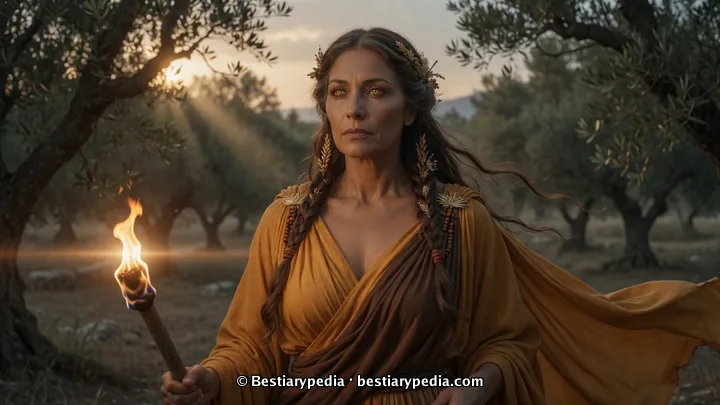
Demeter
Demeter, Greek goddess of agriculture, grain and harvests
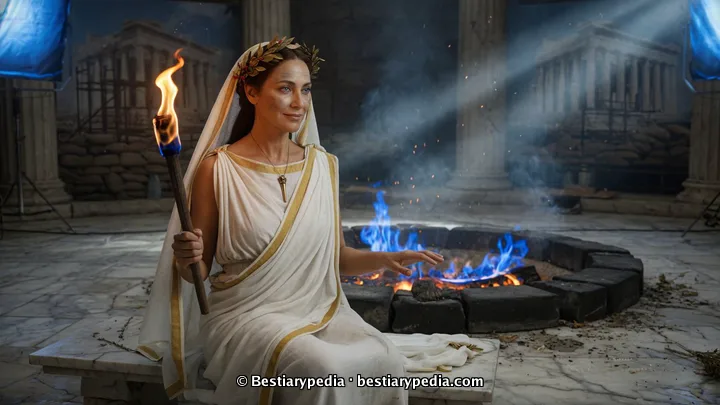
Hestia
Hestia, goddess of the home, sacred fire, and family in Greek mythology
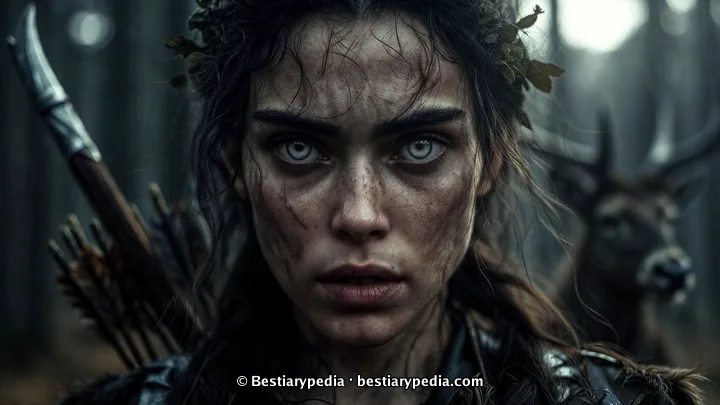
Artemis
Artemis, Greek goddess of the hunt, the moon and chastity
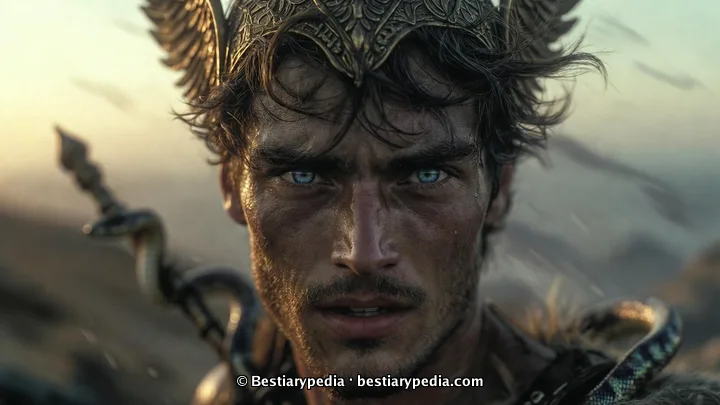
Hermes
Hermes, messenger of the Olympian gods and guide of souls
Hera
Hera, queen of the Olympian gods and goddess of marriage
Athena
Athena, Greek goddess of wisdom, military strategy, arts and justice