Poseidon
Poseidon, god of the sea, earthquakes and horses in Greek mythology
Curated byBestiarypediaCreated onUpdated on
 Ancient Greece(Greece)




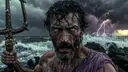
Mythical Origins of Poseidon
Poseidon is the son of the Titans Cronus and Rhea, one of the six divine children whom his father devoured at birth for fear of being dethroned, and whom Zeus later freed. After the Titanomachy, the war that overthrew the Titans, the three brothers (Zeus, Poseidon, and Hades) divided the cosmos by lot: Zeus obtained the sky, Hades the underworld, and Poseidon the seas and oceans as his eternal domain, while the earth and Olympus remained common territory. According to Hesiod in the Theogony, his birth marks the beginning of maritime sovereignty in Greek mythology and establishes his role as lord of the primordial waters. He dwells in a palace in the depths of the sea, near Aegae, and rides over the waves in a chariot drawn by horses.
Domain and Powers of Poseidon
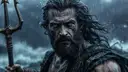
Absolute lord of the seas, Poseidon causes storms, earthquakes, and tidal waves by striking the ground with his trident, a weapon forged by the Cyclopes with which he can split rocks and mountains. Hence his most famous epithet, Enosichthon, «the earth-shaker». He is credited with the creation of the horse and is the patron of navigation and of chariot racing; his wrath unleashes maritime catastrophes and shipwrecks, but he also grants calm seas and safe voyages to pious sailors. His power extends to the oceanic abysses, to springs, and to the fertility of the coasts. He is depicted as a mature, bearded man, majestic and of changeable temperament, similar to his brother Zeus but always bound to the element of water.
Key Myths and Legacy of Poseidon
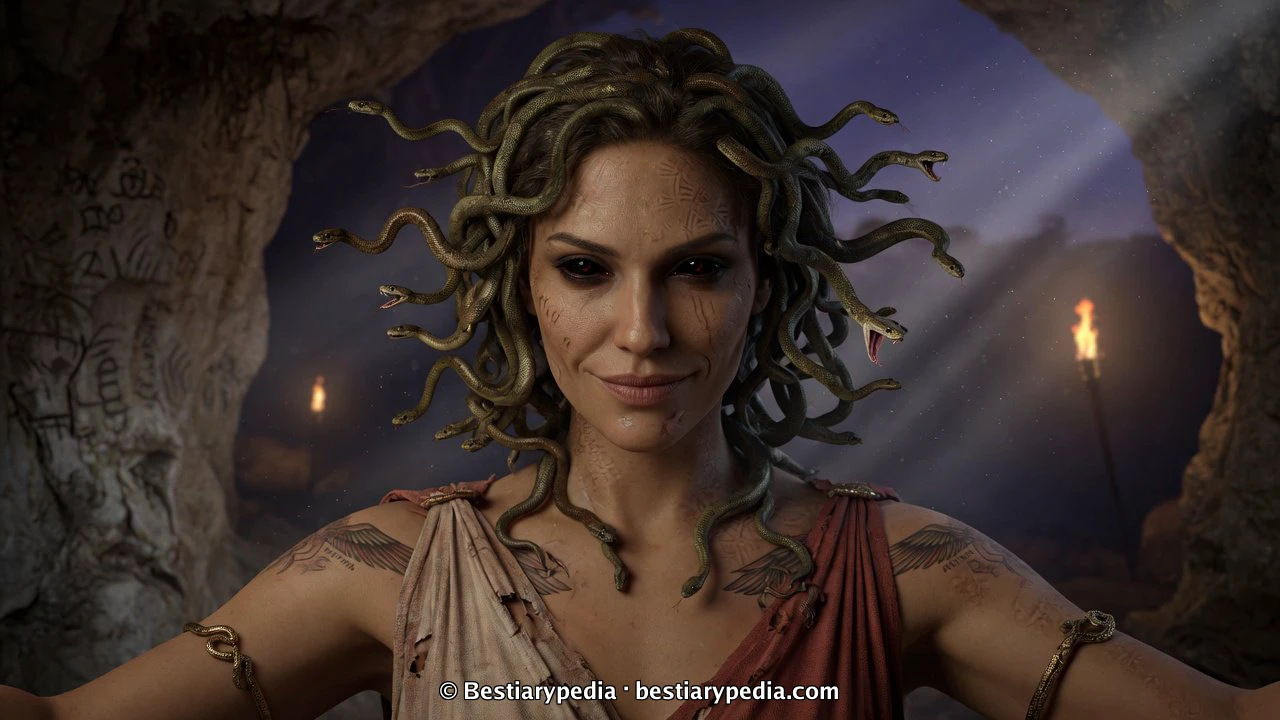
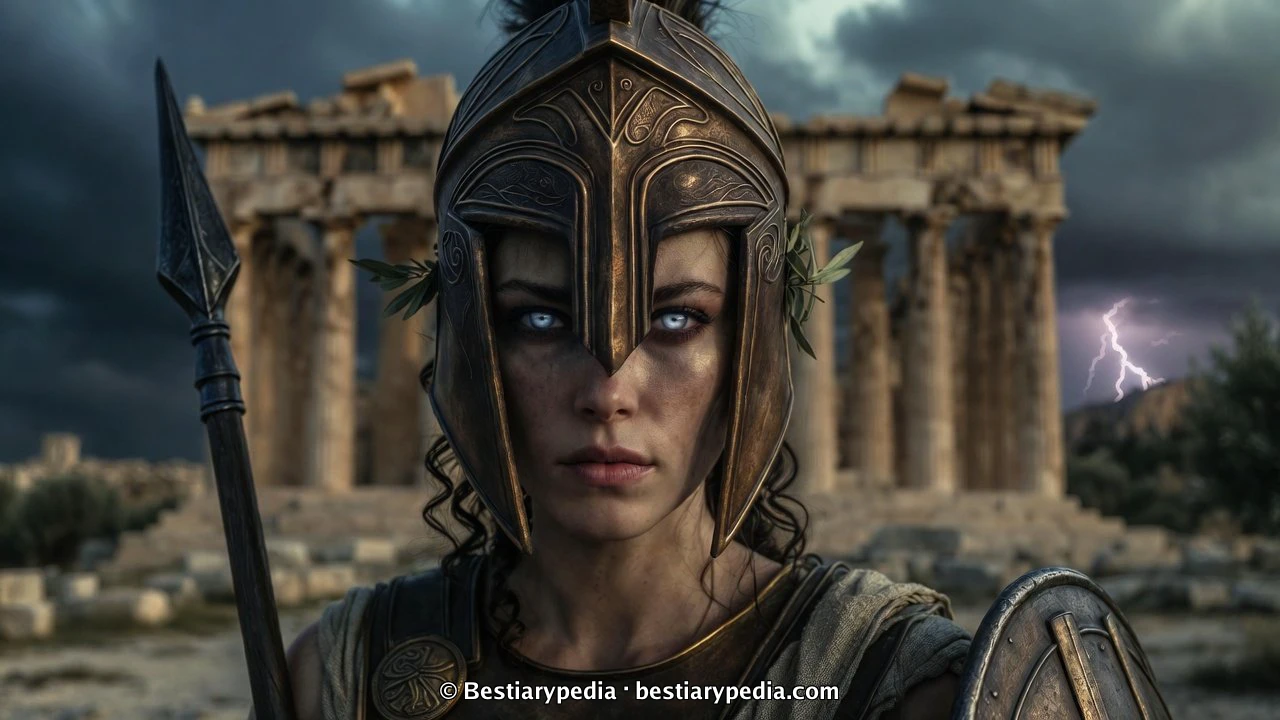
In the Iliad, Poseidon supports the Achaeans (the Greeks) against the Trojans, intervening on their behalf behind Zeus's back, especially in books XIII and XIV; he bears a grudge against Troy because King Laomedon denied him his pay after he built its walls. He disputed with Athena the possession of Attica: Poseidon made a spring of salt water gush forth (or the first horse) by striking the Acropolis with his trident, but the Athenians preferred the olive tree offered by Athena, who gave the city its name and patroness. From his many unions came a wide progeny: Triton, herald of the seas (with Amphitrite); the Cyclops Polyphemus (with the nymph Thoosa); Pegasus and Chrysaor (from his union with Medusa); the prodigious horse Arion (with Demeter) and the hero Theseus (with Aethra). He was not the father of the Minotaur: that creature was born of Pasiphae and the bull that Poseidon himself sent to Minos as a punishment. Worshipped at the Isthmus of Corinth and at Cape Sounion, Poseidon symbolizes the untamable power of the sea in Greek culture, and his trident inspires nautical emblems to this day.
Also known as
Relics
🏺 Poseidon's Trident
Divine weapon controlling seas and earth, forged by Cyclopes.
Symbology
Element
Water
Number
Three
Color
Deep blue
Animals
Horse, Bull
Sigils:
🏷️ Traits
Powers
Weaknesses
Behavioral
Resistances
🔗 Relations with other beings
🗺️In the Atlas
Travel the beings’ world of origin and the cosmos of their dimensions.
📜 Mythologies
Greek mythology developed in Ancient Greece from the Late Bronze Age and reached its most elaborate form during the archaic and classical periods, between the 8th and 4th centuries BCE. It emerged among the Hellenic peoples who inhabited the Greek peninsula, the Aegean islands and the coasts of Asia Minor, and was transmitted mainly through the oral poetry of Homer and Hesiod, as well as local traditions collected in sanctuaries and festivals. Its worldview presents a universe ordered by a hierarchy of divinities that intervene in human and natural affairs, with Olympus as the dwelling of the principal gods and Hades as the destination of the deceased. The central deities include the twelve Olympians, headed by Zeus, god of the sky and sovereign, together with Hera, Poseidon, Athena, Apollo, Artemis, Aphrodite, Ares, Hephaestus, Hermes, Demeter and Dionysus. Before them, the Titans, among whom Cronus and Rhea stand out, ruled the cosmos until they were deposed by the Olympians in the Titanomachy. Other important entities are the Muses, the nymphs, the Cyclopes and the Moirai, who embody cosmic forces and destinies. This tradition exerted a lasting influence on the literature, art and thought of Rome, the European Renaissance and subsequent Western culture, supplying motifs, characters and narrative structures that have endured in philosophy, astronomy and the arts to the present day.
Sources
Homeric Hymns
Anonymous · -600
Collection of thirty-three archaic Greek hymns (7th-6th century BCE) dedicated to the Olympian gods. In epic style they recount their births, attributes and myths, and are a primary source of the divinities of Greek mythology.
Theogony
Hesiod · -700
Poem by Hesiod detailing the origin of Greek gods and Titans.
Iliad
Homero · -800
Homeric epic that presents the Nereids consoling Thetis and participating in funeral rites.
Library
Apollodorus · 100
Mythological compendium attributed to Apollodorus summarizing Greek legends.
Pausanias' Description of Greece
Pausanias · ca. 150 CE
Pausanias’ "Description of Greece" (2nd century), a geographical and religious guide to the Greek world. It tours sanctuaries, monuments and local cults, preserving myths, heroes and divinities that would otherwise have been lost.
Frequently asked questions
What is the mythical origin of Poseidon and how did he obtain his dominion over the seas?
Poseidon is the son of the Titans Cronus and Rhea. After the Titanomachy, brothers Zeus, Poseidon, and Hades divided the cosmos. Poseidon received the seas and oceans as his eternal domain.
What characteristic powers does Poseidon exercise through his trident?
Poseidon unleashes storms, earthquakes, and tsunamis with his trident. He is the creator of horses and patron of navigation. His wrath brings maritime catastrophes, but he grants calm seas to pious sailors.
What familial relations does Poseidon maintain with Zeus and Hades?
Poseidon is the brother of Zeus and Hades. The three shared victory over the Titans and divided the cosmos after the Titanomachy. Poseidon received the seas as his eternal kingdom.
What place does Poseidon occupy in the hierarchy of the Olympian pantheon?
Poseidon is one of the twelve great gods residing on Mount Olympus. As lord of the sea, he forms part of the Olympian pantheon alongside Zeus and Hades after the division of the cosmos.
🔖Cite this entry▾
If you cite this article in an academic, journalistic or editorial publication, use any of these formats:
Bestiarypedia. (2026, July 16). Poseidon. Bestiarypedia. https://bestiarypedia.com/en/beings/poseidon
Free citation with attribution and canonical link for editorial, academic or journalistic use. Full commercial reuse or creation of derivative products requires prior agreement.
Similar beings
Ares
Ares, the Olympian Greek god of war, violence and martial ardor

Persephone
Persephone, goddess of rebirth, vegetation and queen of the underworld
Demeter
Demeter, Greek goddess of agriculture, grain and harvests
Hestia
Hestia, goddess of the home, sacred fire, and family in Greek mythology
Artemis
Artemis, Greek goddess of the hunt, the moon and chastity
Apollo
Apollo, Greek god of music, prophecy, healing, the sun and the arts
Hermes
Hermes, messenger of the Olympian gods and guide of souls
Hera
Hera, queen of the Olympian gods and goddess of marriage