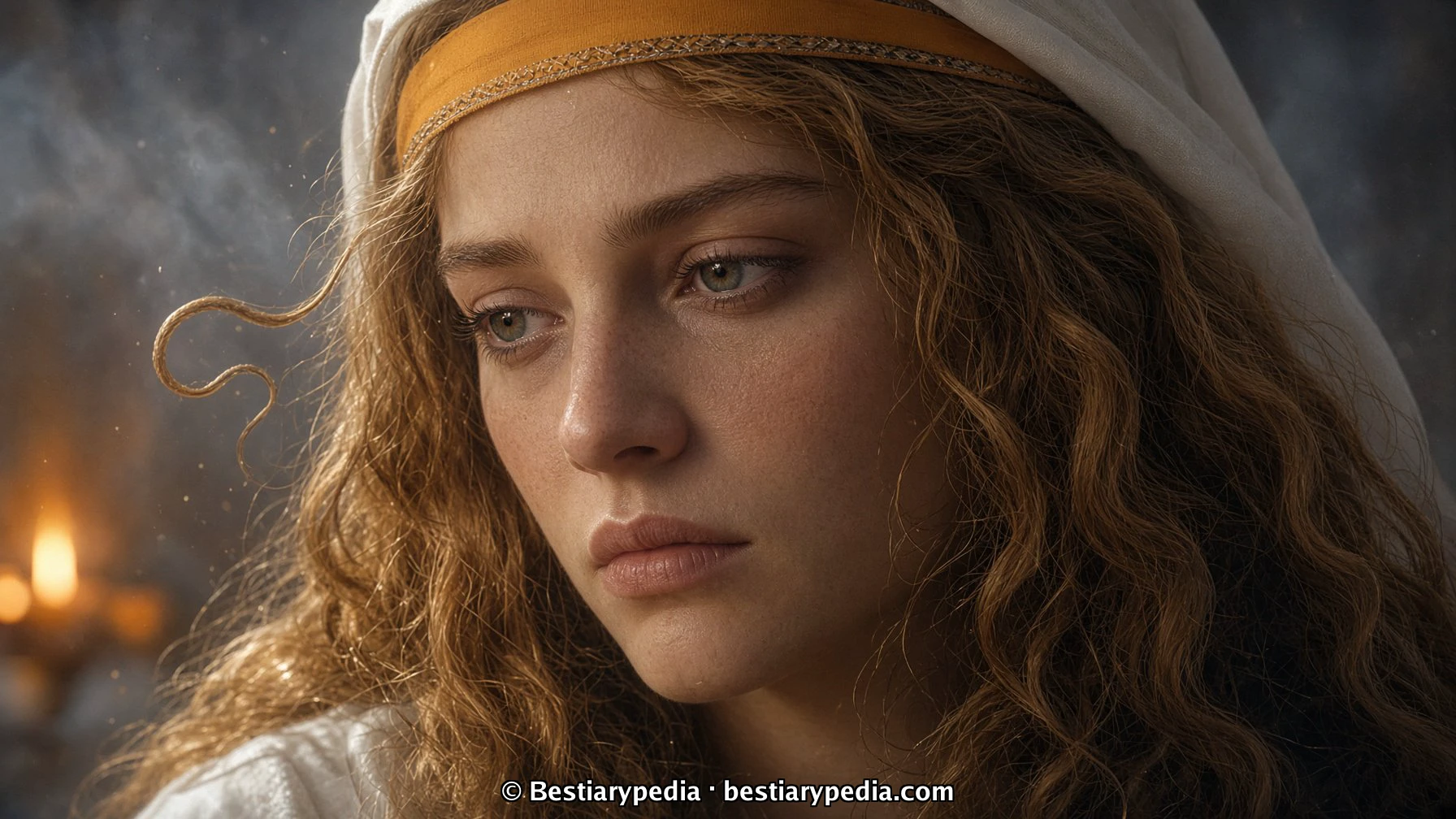
Athena
Greek goddess of wisdom, war and the crafts
Curated byBestiarypediaCreated onUpdated on
 Europe
 Ancient Greece(Greece)Athens(Greece)
Family Tree


Mythical origins of Athena
Hesiod tells in the Theogony that Zeus took Metis as his first wife, the wisest of gods and men, and that when she was about to give birth he deceived her with flattering words and swallowed her: he had been told that she would bear a son able to overthrow him. Afterwards Zeus himself gave birth from his head to Tritogeneia, “the terrible, the rouser of the din of battle, the leader of the host”. The poet says nothing more about the birth. The axe blow comes from other authors: Pindar (Olympian 7) has Hephaestus split his head with a bronze axe and the goddess leap out with a cry that makes sky and earth shudder; Euripides, in the Ion, gives that role to the Titan Prometheus, and Apollodorus records both versions. The golden armour belongs to Homeric Hymn 28, where she is born brandishing her spear and Olympus reels. Pallas, the name that almost always goes with hers, is in Apollodorus that of a childhood companion: raised by the god Triton alongside his daughter Pallas, she killed her by accident in a mock fight and, grieving, carved a wooden image in her likeness, the Palladium. That image ended up in Troy, and the city could not fall as long as it kept it.
Nature and attributes of Athena
She is a virgin, and the Homeric Hymn to Aphrodite counts her among the three goddesses whom desire cannot bend, with Artemis and Hestia. She is a warrior, but not like her brother Ares: in Iliad 5 it is she who drives the spear with which Diomedes wounds him, and in Book 21 she fells him with a stone. Her arms are the helmet, the spear and the aegis of Zeus, which Homer describes with a hundred golden tassels, crowned by Terror and bearing the Gorgon's head amid Strife, Force and Onset. She is also Ergane, goddess of the crafts: Hesiod says she taught Pandora to weave; Apollodorus, that the ship Argo was built on her advice; and Pindar, that she gave Bellerophon the golden bridle with which he tamed Pegasus. The Athenians honoured her as Polias, guardian of the citadel, and every four years, at the Great Panathenaea, they brought her image a new peplos woven for her. Her bird is the owl, which ended up struck on the coins of Athens, and her tree is the olive.
Main myths of Athena
Apollodorus tells of the contest for Attica: Poseidon struck the Acropolis with his trident and brought forth a sea, the salt water still shown there; Athena planted an olive tree, with King Cecrops as witness. Zeus appointed the twelve gods as judges, not Cecrops or Cranaus as others said; the land went to her because she had planted first, and Poseidon, enraged, flooded the Thriasian plain. The version in which the Athenians vote and the women win by one vote is Varro's, known to us through Saint Augustine. In the Iliad she upholds the Achaeans: she guides the spear of Diomedes, seizes Achilles by the hair so that he does not draw his sword on Agamemnon, and deceives Hector in the shape of his brother Deiphobus so that he stays to fight. In the Odyssey she protects Odysseus, appears to him as Mentor and as a young shepherd, and at the end raises the aegis so that the suitors flee in panic. She guided the hand of Perseus against Medusa and afterwards set the Gorgon's head on her shield. In Ovid's Metamorphoses, Arachne challenges her to weave and the goddess can find no fault in her cloth; stung in her pride, she tears it and strikes her with the shuttle, and when Arachne hangs herself, she leaves her hanging, turned into a spider.
Also known as
Relics
Symbology
Element
Air and Earth
Number
7 (the Pythagorean heptad)
Color
Blue and Gold
Animals
Owl, Snake
Sigils:
Traits
Powers
Weaknesses
Behavioral
Resistances
Relations with other beings
Ally of




In the Atlas
Travel the beings’ world of origin and the cosmos of their dimensions.
Mythologies
Greek mythology developed in Ancient Greece from the Late Bronze Age and reached its most elaborate form during the archaic and classical periods, between the 8th and 4th centuries BCE. It emerged among the Hellenic peoples who inhabited the Greek peninsula, the Aegean islands and the coasts of Asia Minor, and was transmitted mainly through the oral poetry of Homer and Hesiod, as well as local traditions collected in sanctuaries and festivals. Its worldview presents a universe ordered by a hierarchy of divinities that intervene in human and natural affairs, with Olympus as the dwelling of the principal gods and Hades as the destination of the deceased. The central deities include the twelve Olympians, headed by Zeus, god of the sky and sovereign, together with Hera, Poseidon, Athena, Apollo, Artemis, Aphrodite, Ares, Hephaestus, Hermes, Demeter and Dionysus. Before them, the Titans, among whom Cronus and Rhea stand out, ruled the cosmos until they were deposed by the Olympians in the Titanomachy. Other important entities are the Muses, the nymphs, the Cyclopes and the Moirai, who embody cosmic forces and destinies. This tradition exerted a lasting influence on the literature, art and thought of Rome, the European Renaissance and subsequent Western culture, supplying motifs, characters and narrative structures that have endured in philosophy, astronomy and the arts to the present day.
Sources
Theogony
Hesiod · 700 BC
Epic poem by Hesiod detailing the origin of Greek gods and Oceanid genealogies.
Metamorphoses
Ovid · 8
Poetic work by Publius Ovidius Naso narrating myths of transformations, including references to Hippolytus and Virbius.
Library
Apollodorus · 100
Mythological compendium attributed to Apollodorus summarizing Greek legends.
Pausanias' Description of Greece
Pausanias · ca. 150 CE
Pausanias’ "Description of Greece" (2nd century), a geographical and religious guide to the Greek world. It tours sanctuaries, monuments and local cults, preserving myths, heroes and divinities that would otherwise have been lost.
Iliad
Homer · 750 BC
Homeric epic that mentions the Nereids in Book XVIII during the lament for Patroclus.
Pindar's Olympian 13
Pindar · 476 BCE
Pindar's 'Olympian 13' (476 BCE) is a victory ode portraying Bellerophon as ideal hero, detailing his taming of Pegasus and Chimera slaying, key poetic source for the myth.
Odyssey
Homer · ~800 BC
Homer's Odyssey (8th century BC) recounts Odysseus's adventures, including the passage by Scylla in Book XII, describing her monstrous form and the sacrifice of six men.
Homeric Hymns
Anonymous · 600 BC
Collection of thirty-three archaic Greek hymns (7th-6th century BCE) dedicated to the Olympian gods. In epic style they recount their births, attributes and myths, and are a primary source of the divinities of Greek mythology.
Frequently asked questions
How was Athena born from the head of Zeus?
Zeus swallowed Metis, his first wife, while she was pregnant, because he had been told that her son would overthrow him. Hesiod says only that he then bore Athena from his head. Hephaestus's axe blow appears in Pindar, Prometheus's in Euripides, and the goddess born already armed in Homeric Hymn 28.
How does Athena differ from Ares as a deity of war?
Ares is slaughter and tumult; Athena is war under direction, the war that defends the city and guides the hero. The Iliad sets them against each other twice: in Book 5 she drives Diomedes' spear into Ares, and in Book 21 she knocks him down with a stone while mocking him.
Why did Athena and Poseidon clash over Athens?
Both wanted Attica. According to Apollodorus, Poseidon brought forth a sea on the Acropolis and Athena planted an olive tree; the twelve gods, acting as judges, gave her the land because she had planted first, and Poseidon took revenge by flooding the plain. In another version, Varro's, the Athenians vote.
What symbols are associated with Athena?
The aegis with the Gorgon's head, the helmet and the spear, the olive tree she gave Athens, and the owl, which ended up on Athenian coins. The Pythagoreans also dedicated the number seven to her, because within the decad it is the number that is neither born of another nor begets any: motherless and virgin, like her.
🔖Cite this entry▾
If you cite this article in an academic, journalistic or editorial publication, use any of these formats:
Bestiarypedia. (2026, September 11). Athena. Bestiarypedia. https://bestiarypedia.com/en/beings/athena
Free citation with attribution and canonical link for editorial, academic or journalistic use. Full commercial reuse or creation of derivative products requires prior agreement.
Similar beings

Hestia
Hestia, goddess of the home, sacred fire, and family in Greek mythology

Zeus
King of the Olympian gods

Poseidon
Greek god of the sea, earthquakes and horses

Melinoe
Melinoe, chthonic goddess of specters and nightmares in the Orphic tradition

Hecate
Hecate, Greek goddess of magic, the moon, and crossroads

Ares
Ares, the Olympian Greek god of war, violence and martial ardor