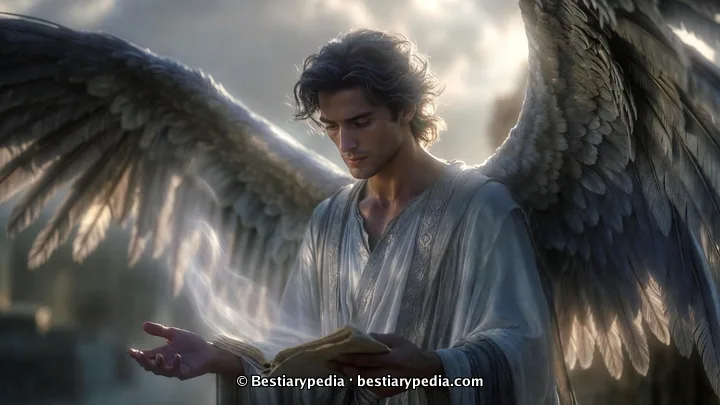
Chamuel
The Archangel of Pure Love
Curated byBestiarypediaCreated onUpdated on
⇄ Cultural variants (1)


Origins of Chamuel
Chamuel (variant of Camael, from the Hebrew 'he who sees God' or 'he who seeks God') is, in the modern esoteric tradition of the seven archangels, the archangel of unconditional love, peace and reconciliation. Although his name is historically the same as that of Camael (the archangel of strength), contemporary angelology, especially theosophy and the currents of the «Ascended Masters» of the 20th century, differentiated him as his own figure dedicated to divine love. In this system, Chamuel rules the «pink ray» of love and is associated with the Kabbalistic sefira of Chesed, the pillar of mercy, channeling the energy of unconditional love towards the world. He is counted among the seven archangels who surround the throne of God, as the one who helps human beings to find love, to forgive and to restore broken bonds.
Attributes and symbology
Chamuel is represented wrapped in a light of pinkish tones, a color that in this tradition symbolizes love and compassion, with an aura of serenity and warmth. His most characteristic symbol is rose quartz, the stone associated with love, and he is attributed the power to dissolve hatred, heal the wounds of the heart and favor reconciliation and encounters. In the tradition of the Ascended Masters he is attributed a feminine counterpart, Charity, with whom he forms a couple or "twin flame" that governs love and gratitude. He is invoked in meditations and rituals dedicated to self-love, emotional healing and the search for inner peace, and he is considered an intermediary who brings divine love to human relationships.
Influence and tradition
The figure of Chamuel as the archangel of love belongs above all to contemporary esoteric and New Age spirituality, more than to classical angelology, where the name is confused with that of Camael. In that modern key, he is invoked to overcome ruptures, find lost objects or people, appease conflicts and cultivate compassion. He shares with Raphael, the healing archangel, the realm of healing (in his case, that of the heart), and he is presented as opposed to the forces that sow hatred and discord. He has been compared with divinities of love from other traditions, such as Eros or Cupid, although his love is understood as spiritual and unconditional rather than romantic or carnal. Chamuel thus embodies, in modern religious sensibility, the loving and reconciling dimension of the divine.
Also known as
Relics
🏺 Rose Quartz
Symbology
Element
Air
Number
4
Color
Pink
Animals
Dove
Sigils:
🏷️ Traits
Powers
Weaknesses
Behavioral
Resistances
🔗 Relations with other beings
Sibling of



🗺️In the Atlas
Travel the beings’ world of origin and the cosmos of their dimensions.
📜 Mythologies
Esoteric and Kabbalistic traditions within Judaism, encompassing Merkabah mysticism from the Talmudic era, 13th-century Zoharic Kabbalah, 16th-century Lurianic Kabbalah, the 18th-century Hasidic movement, and various meditative, contemplative, and visionary practices aimed at ascending through spiritual worlds, invoking divine names, and achieving mystical union with the divine while unraveling the secrets of the creative universe.
Sources
Sefer Raziel HaMalakh
Eleazar of Worms (attributed to Raziel) · 1200
Medieval Jewish grimoire (c. 1200) attributed to the angel Raziel, said to have given it to Adam. It gathers cosmology, angelic names and protective magic; a central reference of esoteric angelology.
De Coelesti Hierarchia
Pseudo-Dionisio Areopagita · 500
Treatise by Pseudo-Dionysius the Areopagite (c. 5th-6th century) establishing the hierarchy of the nine angelic choirs arranged in three triads. The foundation of all later Christian angelology.
Zohar
Moisés de León (atrib.) · c. 1280
Central work of the Kabbalah, which appeared in 13th-century Spain and is attributed to Moses de León. It mystically comments on the Torah and expounds the sefirot, the spiritual worlds and the angelic and demonic powers of Jewish esotericism.
3 Enoch (Hebrew Book of Enoch)
Anonymous · c. 500 CE
The Hebrew Book of Enoch (3 Enoch or Sefer Hekhalot) is a medieval Jewish mystical text (5th-6th c. CE), attributed to Enoch transformed into Metatron. It describes angelic hierarchies, fallen princes like Tamiel, and visions of the heavenly palaces (Hekhalot).
Frequently asked questions
What is Chamuel in the modern esoteric tradition?
Chamuel is the archangel of unconditional love, peace and reconciliation in the modern angelology of the seven archangels, especially theosophy and the currents of the Ascended Masters of the 20th century.
Is Chamuel the same as Camael?
His name is historically the same as that of Camael, the archangel of strength. Contemporary spirituality differentiated him as his own figure dedicated to divine love, while classical angelology confuses both names.
What symbols are associated with Chamuel?
The light of pink tones (the 'pink ray' of love) and pink quartz, the stone of compassion. In the tradition of the Ascended Masters a feminine counterpart, Charity, is attributed to it. The Kabbalah links it to the sephira of Chesed, mercy.
What is Chamuel invoked for?
It is invoked for love, forgiveness and reconciliation, as well as for emotional healing, finding what is lost and cultivating inner peace. It shares with Rafael the realm of healing, in his case that of the heart.
🔖Cite this entry▾
If you cite this article in an academic, journalistic or editorial publication, use any of these formats:
Bestiarypedia. (2026, July 26). Chamuel. Bestiarypedia. https://bestiarypedia.com/en/beings/chamuel
Free citation with attribution and canonical link for editorial, academic or journalistic use. Full commercial reuse or creation of derivative products requires prior agreement.