Hanuman
Vanara devotee of Rama, son of the wind
Curated byBestiarypediaCreated on
 India(India)
 South Asia(India, Nepal)
 Lanka(Sri Lanka)Hampi(India)
The origins of Hanuman
Valmiki tells his birth twice. In Book IV (Kishkindha Kanda 66) Jambavan reminds Hanuman himself: his mother is Anjana, the apsara Punjikasthala, “the loveliest of the apsaras”, reborn on earth as a monkey “owing to a curse” (the text says neither which curse nor whose) and married to the vanara Kesari; he is Kesari's son in law and the wind god Vayu's son by begetting, so leaving Kesari out tells half the genealogy. As a child he saw the newly risen sun, took it for a ripe fruit and leapt at it; Indra hurled the thunderbolt, the fall broke his left cheekbone, and from that comes his name: hanumant, “the one with the jaw”. Vayu withdrew in fury with the child and stopped circulating, and with him stopped the breath of all beings, the sacrifices and the study of scripture, until the gods appeased him with boons. The list of who gave what is in Book VII (Uttara Kanda 36), a later addition: Indra made him proof against the thunderbolt, Surya promised him a hundredth part of his own brilliance and the gift of eloquence, Varuna that neither his noose nor his waters would touch him, Yama that he would not be slain in battle, Kubera gave him his mace, Shiva held back his arrows, and Vishvakarma and Brahma swore that none of their weapons could harm him. It is not immortality: it is dying only when he wills it, and no weapon wounding him.
Appearance and powers
He is shown as a vanara with tawny fur, a red face and a long tail, carrying the mace Kubera gave him. His showiest power is changing size: on the way to Lanka the demoness Surasa demands that he enter her mouth; he grows, she grows with him, and then he shrinks to a tiny thing, goes in and comes out in an instant (Book V, 1). The leap comes from his father: he crosses the sea driven by the wind, though the journey is broken three times — by Mount Mainaka, which rises to offer him rest, by Surasa, and by the rakshasi Simhika, who seizes him by his shadow. His strength moves mountains literally: in Book VI he tears a whole peak from the Himalaya “with its trees, its elephants and its gold”, because he cannot tell which herb he was sent for (VI, 74). He is not fireproof by nature. When the rakshasas set his tail alight the fire does not burn him, and the text gives its own reason: “the fire does not burn me, through the kindness of Sita, the power of Rama and the friendship of my father” (V, 53). He is no less provided with learning: Rama, who has not yet met him, infers from hearing him speak that he has studied the Rig, the Yajur and the Sama and has mastered grammar (IV, 3); the Uttara Kanda adds that he learned that grammar from Surya himself, following him from sunrise to sunset with the book in hand.
Deeds and devotion
Book V of the Ramayana, the Sundara Kanda, is his alone. He leaps to Lanka, walks the city by night and finds Sita in the ashoka grove, in soiled clothes, emaciated and ringed by rakshasi guards (V, 15). Indrajit captures him with the brahmastra, Brahma's weapon, and he lets himself be bound so as to be taken before Ravana (V, 48). When they set his tail alight he burns the city “as Rudra burned Tripura”, sparing a single house, Vibhishana's (V, 54). In the war of Book VI he kills Dhumraksha, Akampana, Devantaka, Trishira and Nikumbha, and twice goes for the mountain of herbs: first for Rama and his brother (VI, 74), then for Lakshmana alone (VI, 101). The name Dronagiri, under which the episode is told today, is not in Valmiki, who speaks of Himavat, of Rishabha and of Mount Oshadhi. His forgetting his own strength is not modesty: it is a curse laid by the sages of the lines of Bhrigu and Angiras, worn out by his childhood mischief (VII, 36), which is why Jambavan has to remind him who he is before the leap. At the end Rama grants what he asks: to stay alive as long as his story is told (VII, 108). That is why he is a chiranjivi, and why the Mahabharata shows him centuries later on Mount Gandhamadana, testing Bhima and promising to ride on Arjuna's banner.
Also known as
Relics
Symbology
Element
Wind
Number
1
Color
Red
Animals
Monkey
Sigils:
Traits
Powers
Weaknesses
Behavioral
Resistances
Relations with other beings

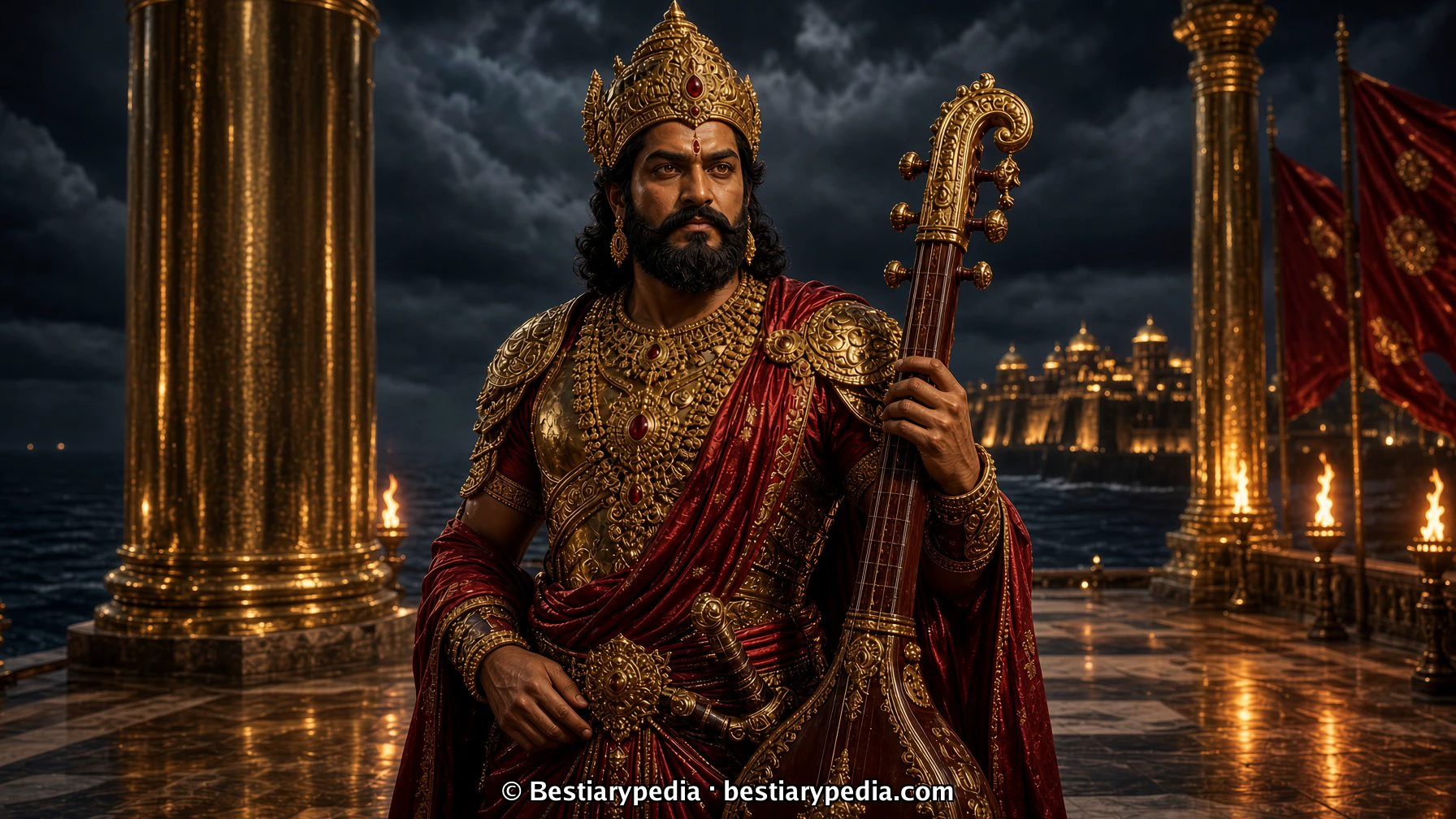

Worshipper of
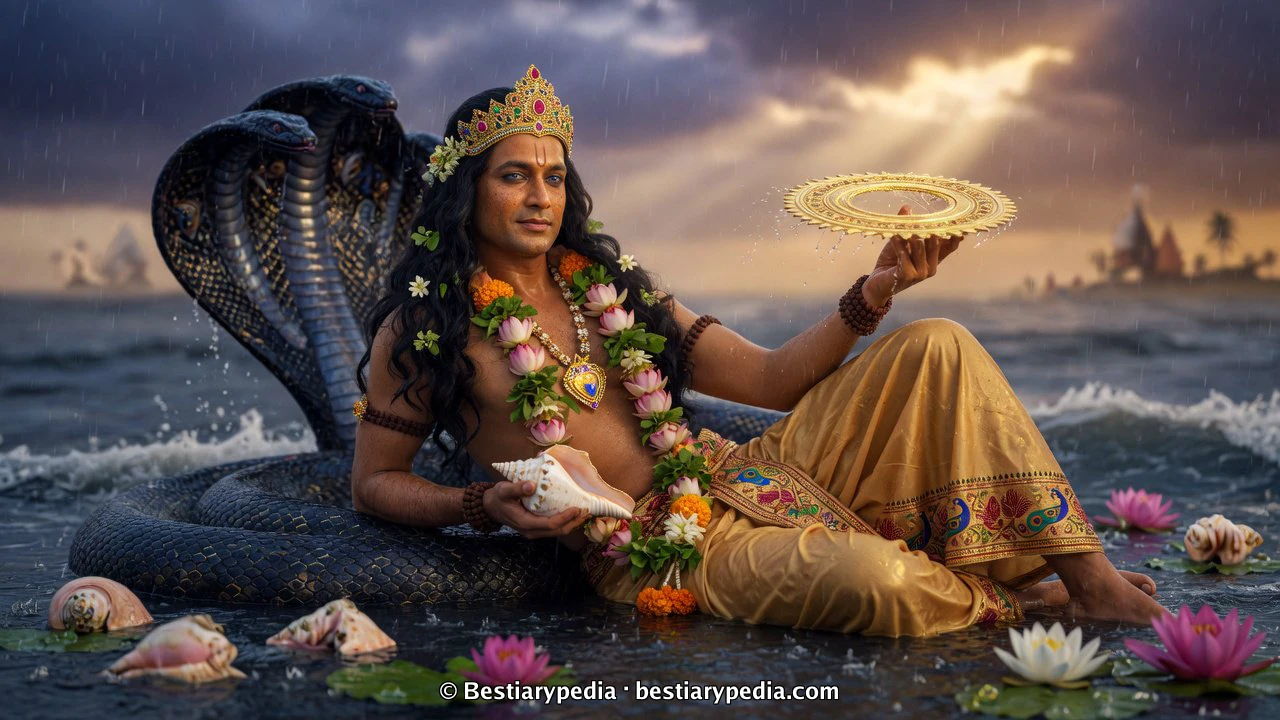
In the Atlas
Travel the beings’ world of origin and the cosmos of their dimensions.
Mythologies
Hindu mythology originated in the Indian subcontinent from the fusion of the traditions of the Indo-Aryan peoples, who arrived around the second millennium BCE, with the pre-existing cultures of the Indus Valley and other local populations. Its foundational texts, such as the Vedas, composed between approximately 1500 and 500 BCE, contain hymns, rituals and narratives that reflect a worldview in which the universe is governed by cosmic order (ṛta) and by cycles of creation, preservation and destruction. The main Vedic deities include Indra, Agni and Varuṇa, while in later periods, especially from the epic texts Mahābhārata and Rāmāyaṇa and the Purāṇas, the triads of Viṣṇu, Śiva and Devī in their various manifestations gain greater relevance. This tradition conceives reality as a web of existences governed by karma and rebirth (saṃsāra), with the ultimate goal of liberation (mokṣa). The epics and Puranic accounts transmit moral, philosophical and ritual teachings that have shaped the religious and social life of much of the Indian subcontinent over the centuries. Its influence extends to the arts, literature and devotional practices of numerous Hindu communities, as well as to other religious traditions of South and Southeast Asia.
Sources
Shiva Purana
Vyasa · circa 800 CE
One of the major Puranas of Hinduism, dedicated to Shiva. It gathers his mythology, hymns and legends—the marriage to Sati and Parvati, the birth of Ganesha and Kartikeya—and describes many deities and beings of the Hindu pantheon.
Valmiki Ramayana
Valmiki (traditionally attributed) · c. 500-100 BCE
Ancient Hindu epic in Sanskrit attributed to the sage Valmiki, narrating the adventures of Prince Rama, his exile, the search for Sita, and the heroic exploits of Hanuman as the devoted vanara leader, warrior monkey with divine powers.
Mahabharata
Vyasa · 400 BC
The great Sanskrit epic of India (compiled between the 4th century BC and the 4th century AD), over 100,000 verses long. It weaves the Kuru war together with theology, philosophy and foundational Hindu myths, and includes the Bhagavad Gita.
Frequently asked questions
Whose son is Hanuman?
Of three, and Valmiki names all three. His mother is Anjana, the apsara Punjikasthala reborn as a monkey through a curse the text never explains; his father in law is the vanara Kesari, her husband; and the one who begets him is Vayu, the wind god (Book IV, 66). Calling him only “son of the wind” leaves Kesari out.
Why does the fire on his tail not burn him?
Because three specific things protect him, and he says so himself in the Ramayana: “the fire does not burn me, through the kindness of Sita, the power of Rama and the friendship of my father” (Book V, 53). It is not a permanent immunity, nor a gift of the gods, and it does not come from any scene in which the sun swallowed him: no text contains that.
What did Hanuman do in Lanka?
He leapt across the sea, searched the city by night and found Sita in the ashoka grove, watched by rakshasis. He let Indrajit's brahmastra capture him so as to be taken before Ravana and be able to speak, and when they set his tail alight he burned all of Lanka except Vibhishana's house. This is Book V of the Ramayana.
Is Hanuman an avatar of Shiva?
He is in the Shaiva tradition: the Shiva Purana tells that it was Shiva who was born as a monkey from Anjana's womb, hence the line of Tulsidas calling him “son of Shankara”. Not in the Ramayana: there he is Vayu's son, and Shiva appears only as one of the gods who grant him a boon. His devotion, in every text, is to Rama.
🔖Cite this entry▾
If you cite this article in an academic, journalistic or editorial publication, use any of these formats:
Bestiarypedia. (2026, September 12). Hanuman. Bestiarypedia. https://bestiarypedia.com/en/beings/hanuman
Free citation with attribution and canonical link for editorial, academic or journalistic use. Full commercial reuse or creation of derivative products requires prior agreement.
Similar beings

Durga
Durga, born to kill Mahishasura

Kali
Kali, who steps from the Goddess's brow

Parvati
Parvati, the daughter of the mountain

Adi Shakti
Adi Shakti, the Great Goddess of Shaktism

Shiva
The destroyer of the Trimurti

Rama
Rama, prince of Ayodhya and seventh avatar of Vishnu