Vishnu
Preserver of the universe, god of the ten avatars
Curated byBestiarypediaCreated on
 India(India)
 South Asia(India, Nepal)Tirupati(India)
Family Tree

The Vedic origins of Vishnu
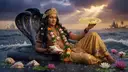
In the Rigveda Vishnu is a minor god: barely one whole hymn belongs to him. What that hymn gives him is the gesture that will be his for ever, the three strides: “I will declare the mighty deeds of Vishnu, of him who measured out the earthly regions… thrice setting down his footstep”, and “within whose three wide-extended paces all living creatures have their habitation” (I, 154). The hymns associate him with the sun, though the text never calls him a solar god, and the collection was composed around 1500-1000 BCE, not before. That he is one of the Adityas, the sons of Aditi, is not in the Rigveda: the Vedic list names Mitra, Aryaman, Bhaga, Varuna, Daksha and Amsha (II, 27). Vishnu enters that list with the Puranas, and the Vishnu Purana (I, 15) puts him first among the twelve sons of Kashyapa and Aditi. The Trimurti (Brahma who creates, Vishnu who preserves and Rudra who destroys) is already formulated in that same Purana (I, 4), comes from the Gupta period and is rooted in the Maitri Upanishad; it was never a cult but a theological scheme, and Brahma never attained the standing of the other two. Vishnu, moreover, is not born: he is. What his literature tells is not his origin but his descents.
The ten avatars
The canonical list of ten runs: Matsya the fish, Kurma the tortoise, Varaha the boar, Narasimha the man-lion, Vamana the dwarf, Parashurama, Rama, Krishna, the Buddha and Kalki, who has not yet come. The oldest dated enumeration is not in a book but in a seventh-century inscription in the Adivaraha cave at Mahabalipuram, and there the eighth is not Krishna but Balarama; that place still changes from school to school. Matsya saves the sage Manu from the flood, though in the oldest version, the Mahabharata's, the fish introduces itself saying “I am Brahma”: the attribution to Vishnu is later. Kurma serves as the pivot under Mount Mandara while the ocean is churned, and Varaha lifts on his tusks the earth sunk in the waters (Vishnu Purana I, 9 and I, 4). Narasimha kills Hiranyakashipu (I, 20). Vamana, the dwarf who grows until he covers the world, is the Vedic myth of the three strides turned into an avatar. From Rama and Krishna come the two great poems, and it is Krishna who tells Arjuna: “whenever piety declines and impiety rises, then do I create myself” (Mahabharata, Bhishma Parva XXVIII). Kalki will be born in the village of Sambhala, in the house of the brahmin Vishnuyashas, and will close the Kali Yuga (Vishnu Purana IV, 24); the white horse is a late detail, for the Bhagavata Purana gives him a mount named Devadatta and the colour comes from the Kalki Purana and from iconography.
Consort, couch and cult
Lakshmi goes with him in every descent, and the Vishnu Purana says so plainly: when he was the dwarf she was Padma; when he was the Rama of Bhrigu's line she was Dharani; when he was Ramachandra she was Sita; when he was Krishna she was Rukmini; “if he takes a celestial form, she appears as divine; if a mortal, she becomes a mortal too” (I, 9). He rests on Shesha, the thousand-headed serpent the gods call Ananta (II, 5); that this couch floats on an ocean of milk is a later refinement, since the Purana says only “the ocean”. His two most famous temples do not show him alike: at the Padmanabhaswamy of Thiruvananthapuram he reclines on the serpent, while at Tirupati, the most visited shrine in India, he stands. Vaishnavas revere him as the supreme Being and recite the Vishnu Sahasranama, his thousand names. About Diwali one should be exact: the most widespread custom is lighting lamps for Lakshmi; in the north the festival also celebrates Rama's return to Ayodhya, and in the south Krishna's victory over Narakasura. And the Buddha entered the avatar lists between the fifth and eighth centuries with a polemical purpose: the Vishnu Purana itself (III, 17-18) presents him as an illusory form sent out to lead the demons astray. Buddhists never accepted that reading.
Also known as
Relics
Symbology
Element
Water
Number
4
Color
Blue
Animals
Garuda, Ananta Shesha
Sigils:
Traits
Powers
Weaknesses
Behavioral
Resistances
Relations with other beings
Companion of

Worshipper of
In the Atlas
Travel the beings’ world of origin and the cosmos of their dimensions.
Mythologies
Hindu mythology originated in the Indian subcontinent from the fusion of the traditions of the Indo-Aryan peoples, who arrived around the second millennium BCE, with the pre-existing cultures of the Indus Valley and other local populations. Its foundational texts, such as the Vedas, composed between approximately 1500 and 500 BCE, contain hymns, rituals and narratives that reflect a worldview in which the universe is governed by cosmic order (ṛta) and by cycles of creation, preservation and destruction. The main Vedic deities include Indra, Agni and Varuṇa, while in later periods, especially from the epic texts Mahābhārata and Rāmāyaṇa and the Purāṇas, the triads of Viṣṇu, Śiva and Devī in their various manifestations gain greater relevance. This tradition conceives reality as a web of existences governed by karma and rebirth (saṃsāra), with the ultimate goal of liberation (mokṣa). The epics and Puranic accounts transmit moral, philosophical and ritual teachings that have shaped the religious and social life of much of the Indian subcontinent over the centuries. Its influence extends to the arts, literature and devotional practices of numerous Hindu communities, as well as to other religious traditions of South and Southeast Asia.
Sources
Rigveda
Anonymous Rishis · 1500 BC
The oldest of the four Vedic collections (c. 1500-1200 BC): over a thousand hymns to the devas, forming the earliest layer of Indian mythology.
Vishnu Purana
Vyasa (traditionally attributed) · c. 400-500 CE
One of the major Puranas of Hinduism, centred on Vishnu (c. 4th-5th century). It sets out the cosmology, divine genealogies and avatars of the god, and describes many deities and beings of the Hindu pantheon.
Mahabharata
Vyasa · 400 BC
The great Sanskrit epic of India (compiled between the 4th century BC and the 4th century AD), over 100,000 verses long. It weaves the Kuru war together with theology, philosophy and foundational Hindu myths, and includes the Bhagavad Gita.
Bhagavata Purana
Vyasa · circa 800-1000 CE
Hindu sacred text narrating the life and teachings of Krishna as avatar of Vishnu.
Frequently asked questions
What place does Vishnu hold in the Rigveda?
A small one. He is a minor god to whom barely one whole hymn belongs, that of the three strides with which he measures the world (I, 154). The hymns brush him against the sun but never call him a solar god, and they do not count him among the Adityas: that list is Puranic. His greatness comes after the Vedas.
What are the ten avatars of Vishnu?
Matsya, Kurma, Varaha, Narasimha, Vamana, Parashurama, Rama, Krishna, the Buddha and Kalki. The oldest dated list is a seventh-century inscription at Mahabalipuram, and there the eighth is not Krishna but Balarama; that place still varies by school. Kalki is the only one who has not yet come.
What is the relation between Vishnu and Lakshmi?
She is his wife, and she descends with him every time. The Vishnu Purana lists it: when he was the dwarf she was Padma; when he was Ramachandra she was Sita; when he was Krishna she was Rukmini. “If he takes a celestial form, she appears as divine; if a mortal, she becomes a mortal too” (I, 9). It is not symbolic company: it is the same couple in every life.
How is he shown in his great temples?
In two different ways, and they should not be confused. At the Padmanabhaswamy of Thiruvananthapuram he reclines on the serpent Ananta Shesha, asleep between two ages. At Tirupati, the most visited shrine in India, he stands, with the discus and the conch in his hands.
🔖Cite this entry▾
If you cite this article in an academic, journalistic or editorial publication, use any of these formats:
Bestiarypedia. (2026, September 12). Vishnu. Bestiarypedia. https://bestiarypedia.com/en/beings/vishnu
Free citation with attribution and canonical link for editorial, academic or journalistic use. Full commercial reuse or creation of derivative products requires prior agreement.
Similar beings

Durga
Durga, born to kill Mahishasura

Kali
Kali, who steps from the Goddess's brow

Parvati
Parvati, the daughter of the mountain

Adi Shakti
Adi Shakti, the Great Goddess of Shaktism

Shiva
The destroyer of the Trimurti

Rama
Rama, prince of Ayodhya and seventh avatar of Vishnu